
Local SEO & GBP
Service-Area Business Website vs Google Business Profile: Do You Need Both?
A straightforward comparison for businesses that travel to customers and need to explain their services, coverage and next steps accurately.
An eligible Google Business Profile can help a service-area business appear in Google’s local surfaces, while a website gives the business space to explain services, coverage, proof and contact routes in depth. They work best when both describe the same real operating model. A profile is not a substitute for a useful website.
Use this service-area business decision framework
This guide is for a service business that wants a useful customer journey, not a larger pile of pages or a decorative SEO exercise. Start with the real service, the customer’s question and the information the business can support. Then use the framework below to decide what should change.
Use this guide as a decision framework, then check the relevant pages, evidence and contact route before making a change. A service-area business review should make the next action clearer for both the business and the customer.
| Customer need | Website contribution | Google Business Profile contribution |
|---|---|---|
| Understand the full service | Detailed service pages, process and boundaries | Concise categories, services and description |
| Check coverage | Clear service-area explanation and relevant pages | Accurate service area for eligible profiles |
| Compare proof | Approved examples and contextual evidence | Customer reviews and current public details where available |
| Contact the business | Forms, calls, booking routes and supporting information | Calls, directions where applicable and profile actions |
A profile and a website solve different parts of the journey
A service-area business website vs Google Business Profile comparison becomes clearer when the customer journey is separated. A profile is designed to show concise public business information in Google’s local products. A website can explain a specialised service, customer fit, scope, process and the questions a customer asks before making contact.
Neither channel removes the need for accurate information. If the business says it serves one area on its website and another on a profile, customers receive a confusing signal. The goal is not to make the two channels identical but to make them consistent.
Confirm eligibility before planning the profile
A Google Business Profile is not a license to create a local presence. Eligibility and representation rules matter. A business should use its real operating model, hide an address when appropriate for a service-area business and avoid virtual offices or invented locations.
This guide cannot confirm a particular business is eligible. Read Google’s current guidance and make the profile reflect the real customer-facing setup. When eligibility is uncertain, concentrate first on the website, accurate public information and the service journey.
Use the website to explain what the profile cannot hold
A customer may need more than a category and a short description. The website can give each important service a useful home, explain who it is for, answer common questions, show truthful evidence and make the first contact route understandable. Those details help the customer assess fit before they call.
This is why a service-area business website vs Google Business Profile decision should not be framed as one or the other. A good profile can lead a customer to the website, while a useful website can support a more confident profile visit or direct enquiry.
Describe real coverage without implying an office
A service-area business can explain the cities, regions or types of area it genuinely serves. It should not present every named place as a branch. Use plain language about travel, availability and any limits that matter to a customer’s decision.
A page about coverage is valuable when it answers real questions: does the business travel there, what service is offered there, are there practical constraints and what is the next action? It is not valuable when it merely repeats a list of place names.
Keep categories, services and public details aligned
The service names used on the website should broadly agree with the services a customer finds in public listings. The business name, telephone number, email, opening arrangements and service area should be checked whenever they change. Accuracy gives customers fewer reasons to question the business.
Do not add services or areas just because they have search demand. The profile and website should describe what is genuinely available. This protects customer expectations and avoids creating a larger promise than the business can deliver.
Build local confidence with real evidence
A profile may show reviews and photographs, while a website can offer more decision context. Both depend on truth. Use genuine customer feedback, approved project images, accurate business details and useful service explanations where they exist. Do not manufacture reviews, projects or local claims to make a page look established.
For businesses still building a public record, start with service clarity, accurate coverage and a reliable enquiry route. Add evidence gradually as it becomes real and approved for use.
Measure the two routes separately
A profile view, website visit, telephone call and completed form are not the same outcome. Track them separately where measurement is available, and review whether the enquiries match the service and area the business wants to serve.
The useful result of a service-area business website vs Google Business Profile review is a clearer priority list. It may show that the website needs better service pages, the profile needs accurate details, or that the business must resolve eligibility before investing time in local-profile work.
Put this decision into a working review
A service-area business review is more useful when it is carried out with the people who know the service and the customer journey. They can confirm what customers need before contact, where the current explanation creates uncertainty and whether the public information still reflects how the business works. This avoids an attractive but inaccurate change.
Begin with one priority service or customer journey rather than attempting to revise the entire site in a single session. Read the relevant page from the perspective of someone who has arrived directly from a search result. Can that person understand the offer, assess fit, find the information that affects their choice and complete a sensible next action?
Use existing evidence where it is available: real enquiry messages, questions asked in calls, page-entry data, completed form records and feedback from the people who respond to customers. This is more reliable than assuming that every low-conversion page has the same cause. It also creates a stronger basis for future content, design and technical decisions.
Checks to make before changing the page
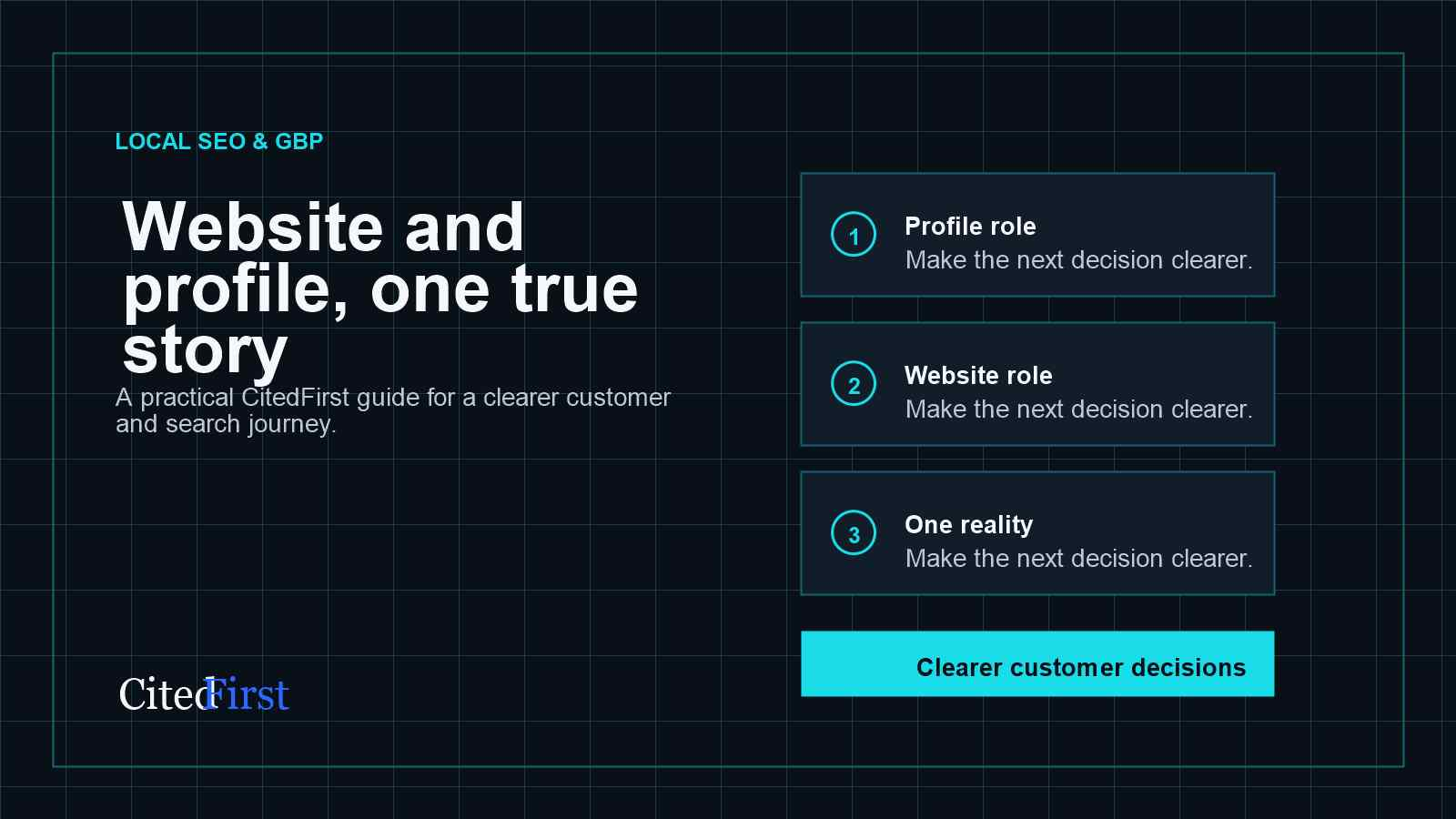
- Profile role: A profile supports local discovery for eligible businesses. Check whether it is accurate on the page a customer is most likely to visit first.
- Website role: A website explains the offer, coverage, proof and next step in more depth. Check whether it is accurate on the page a customer is most likely to visit first.
- One reality: Both should show the same genuine service and operating information. Check whether it is accurate on the page a customer is most likely to visit first.
Do not make a claim clearer by making it bigger than the truth. If the business has a boundary, a dependency, an eligibility condition or a service-area limit, explain it in straightforward language. This can reduce unsuitable enquiries while helping the right customer feel more confident about making contact.
Use the framework in a real customer journey
- Understand the full service: Concise categories, services and description Review detailed service pages, process and boundaries against what the customer can reasonably know and do at this point.
- Check coverage: Accurate service area for eligible profiles Review clear service-area explanation and relevant pages against what the customer can reasonably know and do at this point.
- Compare proof: Customer reviews and current public details where available Review approved examples and contextual evidence against what the customer can reasonably know and do at this point.
- Contact the business: Calls, directions where applicable and profile actions Review forms, calls, booking routes and supporting information against what the customer can reasonably know and do at this point.
Keep notes on what was changed, when it changed and the reason for the decision. A page may be affected by seasonality, demand, availability, advertising, technical changes or follow-up quality. A basic record prevents the business from giving credit or blame to a single edit without enough evidence.
What a useful result looks like
The immediate result should be a clearer page and a more understandable next step. Over time, the business can look for stronger query alignment, more suitable contact actions, fewer repeated pre-enquiry questions and better internal routes between related pages. These are signals to review, not promises of a fixed outcome.
Where the review identifies a wider problem, connect it to the correct owner: a service page for offer clarity, a location page for genuine coverage, a guide for an earlier-stage decision, a form route for contact friction or a technical task for access and delivery. This keeps the website coherent as it grows.
Finally, revisit the page when the service, proof, customer questions or operating details change. Maintaining a clear source is more valuable than publishing a large number of pages that become inaccurate or repetitive over time.
Turn the next decision into a clear priority
CitedFirst reviews the important pages, customer questions, visibility signals and next actions together, then identifies a practical place to begin.
Request a Free Visibility PlanA short service-area business action plan
- Choose one customer decision that matters commercially.
- Check the page that currently owns that decision.
- Compare visible information with what a customer still needs to know.
- Remove unsupported claims and correct inaccurate public details.
- Test the next step on desktop and mobile.
- Review relevant search and enquiry evidence before adding more pages.
A useful service-area business change should help a customer understand the business more easily. Record what changed and why. That makes it possible to review the effect later without assuming that one edit caused every movement in visibility or enquiries.
Use the decision consistently
These final checks keep the page focused on what a customer needs to understand, rather than adding information only to make the page look larger.
- A service-area business should describe how it reaches customers in plain language.
- A service-area business should use only genuine coverage and accurate public information.
- A service-area business should not imply that every place it serves is a staffed office.
- A service-area business should keep its website and eligible public profile aligned.
- A service-area business should explain service fit before asking for location details.
- A service-area business should review travel, availability and coverage statements regularly.
- A service-area business should use real evidence rather than invented local proof.
- A service-area business should give customers a practical route to check whether they are in scope.
- A service-area business should describe how it reaches customers in plain language.
Use the outcome of this review to improve the relevant owner page, the supporting guidance and the next contact route together.
Keep the change proportionate. A small clarification may be enough when the service is already clear, while a larger structural problem may need a service-page review, a navigation change or a carefully planned redesign. The useful next move is the one that removes the customer’s uncertainty without creating a second page that repeats the first.
Before acting, check the information with the people responsible for the service. Confirm the scope, coverage, evidence and contact process. This prevents the page from becoming outdated or making the customer a promise that the business did not intend to make.
Frequently asked questions
Can a service-area business have a Google Business Profile?
Some service-area businesses may be eligible, but the profile must represent the real operating model and follow Google’s current guidelines. Do not create a false location to qualify.
Do I need a website if I have a Google Business Profile?
A website remains useful for explaining services, coverage, proof, customer fit and detailed contact routes. A profile has a different, more concise role.
Should I show my home address on the website?
Only publish an address when it is accurate, appropriate for customers and consistent with how the business operates. Service-area businesses should follow the relevant platform guidance for their setup.
Can I list every area I want to work in?
List areas the business genuinely serves. Do not imply a physical presence or create coverage claims that cannot be supported.
Does a Business Profile guarantee Maps visibility?
No. A profile can support eligibility and accurate local information, but it does not guarantee a specific ranking or customer outcome.
Continue with the relevant CitedFirst service
This guide explains the decision. The service page explains how CitedFirst approaches the connected commercial work and the next practical step.
Explore Local SEO ServicesSources and further guidance
Start with the pages and information that matter most
The Free Visibility Plan is a focused route to review the website, customer journey and public visibility information before deciding what to improve.
Request your Free Visibility Plan