
SEO Strategy
How to Choose an SEO Agency in the UK for a Service Business
A buyer guide for service businesses comparing SEO support and looking for clear thinking, honest scope and a useful working relationship.
To choose an SEO agency in the UK, ask how it will understand the business, map customer demand to owner pages, explain priorities, measure meaningful progress and communicate limits. Be cautious of guaranteed rankings, unexplained tactics or an offer that cannot say what will be reviewed and why.
Use this choose SEO agency decision framework
This guide is for a service business that wants a useful customer journey, not a larger pile of pages or a decorative SEO exercise. Start with the real service, the customer’s question and the information the business can support. Then use the framework below to decide what should change.
Use this guide as a decision framework, then check the relevant pages, evidence and contact route before making a change. A choose SEO agency review should make the next action clearer for both the business and the customer.
| Question to ask | A useful answer sounds like | Reason for caution |
|---|---|---|
| How will you learn our business? | We will review services, customers, pages, evidence and search intent. | We use the same package for every business. |
| What will you change first? | Here is the diagnosis and the reason for the priority order. | We cannot say until after a long contract. |
| How will progress be measured? | We will discuss relevant queries, pages, technical health and conversions. | We guarantee position one. |
| Who will work on the account? | Here is the role and communication route. | The delivery team is unclear. |
Start with the business problem, not the agency package
When you choose an SEO agency UK businesses should begin with their own commercial question. Is the problem that suitable customers cannot find an important service? Are pages unclear? Is local coverage inconsistent? Are enquiries poor-fit? A useful agency should help separate these issues rather than sell the same answer to every business.
Write down the services, customer types, operating areas, existing pages and questions that matter most. This gives the conversation a real brief and makes it easier to see whether an agency understands the business or only repeats general search terminology.
Ask how the agency will decide what page owns a query
Good SEO work needs a clear relationship between customer demand and the page that should answer it. An agency should be able to explain how it distinguishes a service page, location page, sector page, guide or contact route. Without this, sites often accumulate pages that compete with one another.
When you choose an SEO agency UK support should be judged by the quality of its reasoning, not by the number of new URLs proposed. A smaller set of pages with clear roles may be more useful than a large template rollout.
Ask what evidence and access the work requires
Accurate service pages need correct business information, genuine proof and a way to review changes. An agency may need access to the website, Search Console, analytics or existing customer information, but it should explain why each input is needed and how decisions will be made.
Be cautious of a plan that promises local authority, reviews, citations or case studies without discussing what is true, approved and available. Sustainable content should strengthen real information rather than invent it.
Ask how recommendations will be prioritised
A useful plan identifies the issues that block customers or search systems first. That may involve technical access, indexing, service-page clarity, internal links, form delivery, location evidence or a redesign risk. The priority order should be understandable in business terms.
Not every issue needs to be fixed at once. When you choose an SEO agency UK support should include a way to distinguish urgent defects from longer-term improvements, with enough explanation for the business to make an informed decision.
Ask about measurement without demanding a guarantee
Search demand, competition, availability, website changes and platform behaviour all affect performance. An agency can measure impressions, queries, landing pages, technical issues, contact-route use and enquiry quality where data exists. It cannot responsibly guarantee a particular ranking or number of leads.
Look for reports that explain what changed, why it was changed, what evidence is being reviewed and what the next decision is. A long list of activities is less useful than a clear account of the work and its commercial relevance.
Check the working relationship and communication
SEO work often touches copy, design, development, customer evidence and business decisions. Ask who will communicate, how questions are handled, what review is expected from the business and how recommendations are documented. A good working relationship makes changes safer and easier to maintain.
No agency should imply that a business can hand over all responsibility for accuracy. The company still needs to confirm service scope, locations, credentials, customer proof and operational facts.
Use the conversation to compare clarity, not sales pressure
The right partner should make the problem easier to understand. They should be prepared to state limitations, avoid false certainty and explain where evidence is missing. A business can compare how each agency approaches the same initial question, not only the headline price or list of deliverables.
To choose an SEO agency UK businesses should prefer a route that respects customers, protects the website and creates a record of useful decisions. That is a healthier starting point than a promise that cannot be verified.
Put this decision into a working review
A choose SEO agency review is more useful when it is carried out with the people who know the service and the customer journey. They can confirm what customers need before contact, where the current explanation creates uncertainty and whether the public information still reflects how the business works. This avoids an attractive but inaccurate change.
Begin with one priority service or customer journey rather than attempting to revise the entire site in a single session. Read the relevant page from the perspective of someone who has arrived directly from a search result. Can that person understand the offer, assess fit, find the information that affects their choice and complete a sensible next action?
Use existing evidence where it is available: real enquiry messages, questions asked in calls, page-entry data, completed form records and feedback from the people who respond to customers. This is more reliable than assuming that every low-conversion page has the same cause. It also creates a stronger basis for future content, design and technical decisions.
Checks to make before changing the page
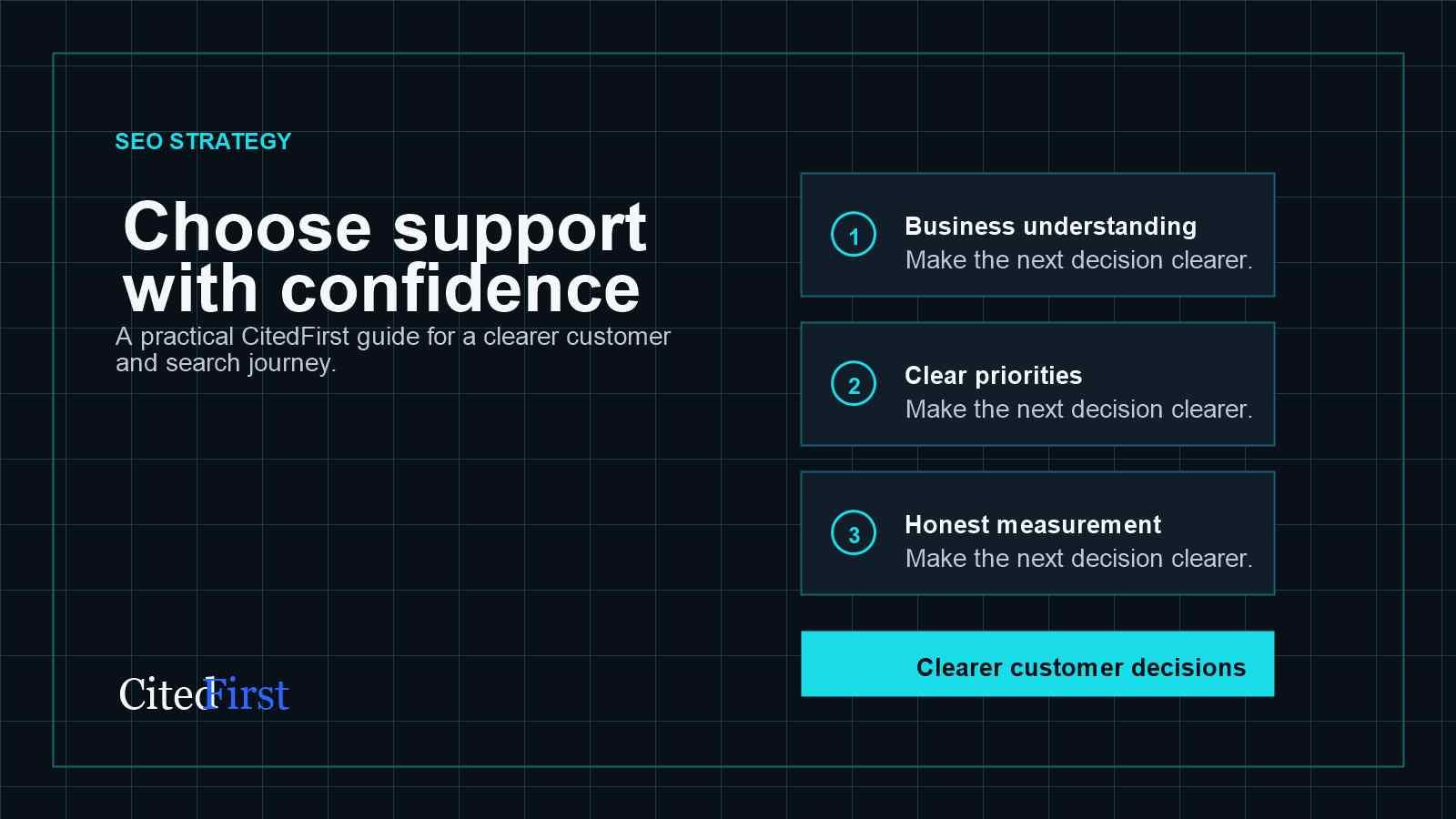
- Business understanding: The work should connect to the services, customers and areas that matter. Check whether it is accurate on the page a customer is most likely to visit first.
- Clear priorities: An agency should explain what it will examine and why that order is sensible. Check whether it is accurate on the page a customer is most likely to visit first.
- Honest measurement: Reporting should connect changes to visibility, customer journeys and outcomes where possible. Check whether it is accurate on the page a customer is most likely to visit first.
Do not make a claim clearer by making it bigger than the truth. If the business has a boundary, a dependency, an eligibility condition or a service-area limit, explain it in straightforward language. This can reduce unsuitable enquiries while helping the right customer feel more confident about making contact.
Use the framework in a real customer journey
- How will you learn our business?: We use the same package for every business. Review we will review services, customers, pages, evidence and search intent. against what the customer can reasonably know and do at this point.
- What will you change first?: We cannot say until after a long contract. Review here is the diagnosis and the reason for the priority order. against what the customer can reasonably know and do at this point.
- How will progress be measured?: We guarantee position one. Review we will discuss relevant queries, pages, technical health and conversions. against what the customer can reasonably know and do at this point.
- Who will work on the account?: The delivery team is unclear. Review here is the role and communication route. against what the customer can reasonably know and do at this point.
Keep notes on what was changed, when it changed and the reason for the decision. A page may be affected by seasonality, demand, availability, advertising, technical changes or follow-up quality. A basic record prevents the business from giving credit or blame to a single edit without enough evidence.
What a useful result looks like
The immediate result should be a clearer page and a more understandable next step. Over time, the business can look for stronger query alignment, more suitable contact actions, fewer repeated pre-enquiry questions and better internal routes between related pages. These are signals to review, not promises of a fixed outcome.
Where the review identifies a wider problem, connect it to the correct owner: a service page for offer clarity, a location page for genuine coverage, a guide for an earlier-stage decision, a form route for contact friction or a technical task for access and delivery. This keeps the website coherent as it grows.
Finally, revisit the page when the service, proof, customer questions or operating details change. Maintaining a clear source is more valuable than publishing a large number of pages that become inaccurate or repetitive over time.
Turn the next decision into a clear priority
CitedFirst reviews the important pages, customer questions, visibility signals and next actions together, then identifies a practical place to begin.
Request a Free Visibility PlanA short choose SEO agency action plan
- Choose one customer decision that matters commercially.
- Check the page that currently owns that decision.
- Compare visible information with what a customer still needs to know.
- Remove unsupported claims and correct inaccurate public details.
- Test the next step on desktop and mobile.
- Review relevant search and enquiry evidence before adding more pages.
A useful choose SEO agency change should help a customer understand the business more easily. Record what changed and why. That makes it possible to review the effect later without assuming that one edit caused every movement in visibility or enquiries.
Use the decision consistently
These final checks keep the page focused on what a customer needs to understand, rather than adding information only to make the page look larger.
- To choose SEO agency support well, begin with the business problem rather than a generic package.
- To choose SEO agency support, ask how the work will be prioritised and measured.
- To choose SEO agency support, check whether the provider can explain page ownership and customer intent.
- To choose SEO agency support, be cautious of ranking or lead guarantees.
- To choose SEO agency support, confirm who will communicate and what information the business must provide.
- To choose SEO agency support, compare the clarity of the diagnosis as well as the headline offer.
- To choose SEO agency support, expect honest boundaries where evidence or access is missing.
- To choose SEO agency support, make sure the proposed work protects the customer journey.
- To choose SEO agency support well, begin with the business problem rather than a generic package.
- To choose SEO agency support, ask how the work will be prioritised and measured.
- To choose SEO agency support, check whether the provider can explain page ownership and customer intent.
- To choose SEO agency support, be cautious of ranking or lead guarantees.
- To choose SEO agency support, confirm who will communicate and what information the business must provide.
- To choose SEO agency support, compare the clarity of the diagnosis as well as the headline offer.
- To choose SEO agency support, expect honest boundaries where evidence or access is missing.
- To choose SEO agency support, make sure the proposed work protects the customer journey.
- To choose SEO agency support well, begin with the business problem rather than a generic package.
- To choose SEO agency support, ask how the work will be prioritised and measured.
- To choose SEO agency support, check whether the provider can explain page ownership and customer intent.
Use the outcome of this review to improve the relevant owner page, the supporting guidance and the next contact route together.
Keep the change proportionate. A small clarification may be enough when the service is already clear, while a larger structural problem may need a service-page review, a navigation change or a carefully planned redesign. The useful next move is the one that removes the customer’s uncertainty without creating a second page that repeats the first.
Before acting, check the information with the people responsible for the service. Confirm the scope, coverage, evidence and contact process. This prevents the page from becoming outdated or making the customer a promise that the business did not intend to make.
Frequently asked questions
What should I ask before choosing an SEO agency in the UK?
Ask how the agency will understand your business, prioritise work, map customer questions to pages, measure progress, communicate and handle claims it cannot guarantee.
Can an SEO agency guarantee rankings?
No responsible agency can guarantee a specific ranking because search results and customer demand are influenced by many factors outside a single provider’s control.
Should I choose the agency that promises the most pages?
Not necessarily. Pages should have a clear customer purpose and enough unique information to earn their place.
What should SEO reporting include?
It should explain the work completed, the reason for priorities, relevant visibility or journey evidence and the next recommended decision.
Do I need to provide evidence to an SEO agency?
Yes. The business remains the source of truth for services, coverage, approvals, credentials, customer proof and operational information.
Continue with the relevant CitedFirst service
This guide explains the decision. The service page explains how CitedFirst approaches the connected commercial work and the next practical step.
Explore How CitedFirst WorksSources and further guidance
Start with the pages and information that matter most
The Free Visibility Plan is a focused route to review the website, customer journey and public visibility information before deciding what to improve.
Request your Free Visibility Plan