
SEO Strategy
Service Pages vs Location Pages: How Should a Local Business Structure Its Website?
A practical way to decide which pages your website genuinely needs, how they should work together and when a separate service-location page would be useful rather than repetitive.
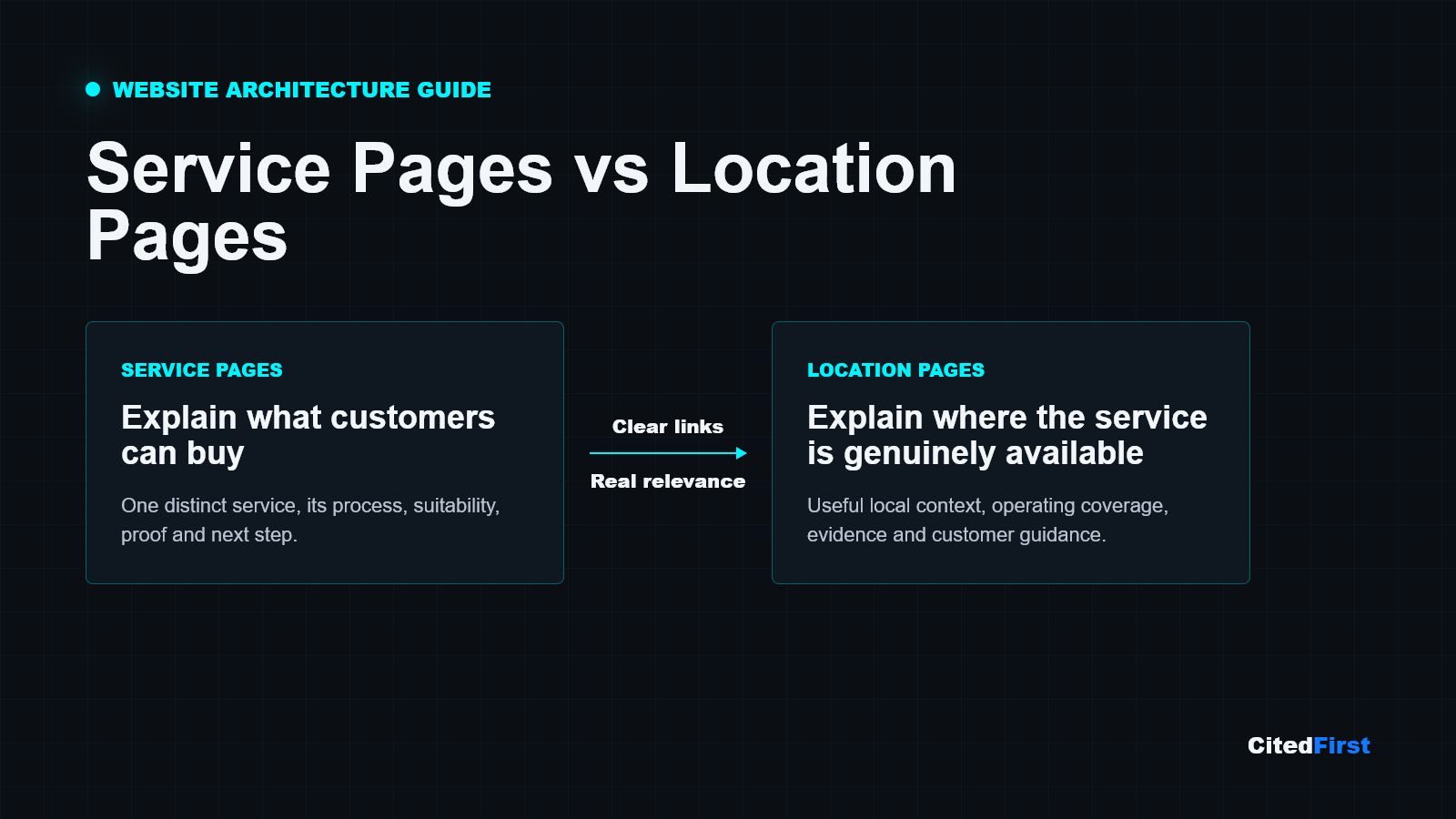
Service pages explain what customers can buy. Location pages explain where those services are genuinely available and why the business is relevant there. Many local businesses need both, but not every service and area combination deserves its own page. Create a separate page only when it solves a distinct customer need and can contain useful, specific information.
What is the difference between a service page and a location page?
The service pages vs location pages decision starts with purpose. A service page is organised around a specific thing the business provides. A location page is organised around a genuine market, branch or service area. They can support the same customer journey, but they answer different questions.
| Page type | Main customer question | Useful content | Typical next step |
|---|---|---|---|
| Service page | Can this company solve my specific problem? | Scope, suitability, process, proof, pricing approach, FAQs and enquiry route | Request a quote, assessment or consultation |
| Location page | Does this company genuinely serve my area? | Operating coverage, local service information, relevant projects, branch details where real, local proof and contact options | Choose an appropriate service or make a local enquiry |
| Service-location page | Can I get this particular service in this particular area? | Area-specific service availability, constraints, examples, customer guidance and meaningful local evidence | Enquire about that service in that area |
What should a strong service page contain?
A service page should help a potential customer understand whether the service is right for them. That usually requires more than a short description and a contact button.
- A clear explanation of the problem or need the service addresses.
- Who the service is suitable for and when another option may be better.
- The practical scope, process and expected next step.
- Relevant evidence such as approved projects, examples, credentials or customer feedback.
- Answers to the questions customers ask before making contact.
- Links to related services, useful guidance and genuine operating locations.
If two services have different customers, processes, proof or buying decisions, separate pages can make both the website and the enquiry journey clearer. If the difference is only a small feature or label, one well-structured page may be enough.
What should a useful location page contain?
A location page should demonstrate genuine relevance to an area. Mentioning roads, landmarks or neighbourhood names is not useful by itself. Local details should help a customer understand availability, practical coverage, experience or the next step.
- Which services are genuinely available in the area.
- How coverage works, including any practical limits or response considerations.
- A real branch address and opening information only when the business actually operates a staffed customer-facing location.
- Relevant approved projects, examples, reviews or partnerships connected with the area.
- Local questions that materially affect the service.
- Clear links to the relevant service pages and enquiry route.
Unsure which pages your website actually needs?
CitedFirst plans service, location and internal-link structures around real customer journeys, commercial priorities and useful search intent.
Explore CitedFirst SEO ServicesFour common website structures
The right service pages vs location pages structure depends on how the business operates. These four models provide a useful starting point.
A focused service page may also explain the genuine operating area. A separate location page is unnecessary when it would repeat the same information.
Use a service hub and distinct pages for important services. The main location or contact page can explain where the business operates.
Keep a strong central service page. Add location pages only where each area has meaningful differences, evidence or customer guidance.
Build clear service and location hubs first. Add selected service-location pages only for combinations that deserve a distinct customer journey.
When does a service-location page deserve to exist?
A service-location page can be useful when a customer has a distinct need at the intersection of a service and an area. It should not be created automatically for every possible combination.
Create the page when you can answer yes to most of these questions
- Is the service genuinely available in this area?
- Do customers search or make decisions around this specific combination?
- Is there enough distinct information to help someone choose or enquire?
- Can the page include real evidence, practical coverage or meaningful local detail?
- Will it serve a different purpose from the main service and location pages?
- Can it be maintained when services, coverage or evidence change?
Google describes doorway abuse as sites or pages created to rank for similar queries that funnel users toward one destination. A large set of near-identical city pages creates poor customer value and unnecessary maintenance risk.
Use a page ownership check before adding another URL
Before a business creates a new page, it should be possible to state the customer question that page owns in one sentence. If the answer is vague, or could be answered by an existing service or location page without making that page confusing, the new URL is unlikely to add much value.
Start with the page a customer would expect to find after a search. A service page should own the decision about whether the business can deliver the work. A location page should own the decision about whether the business genuinely serves the place. A project or case study should own proof of relevant completed work. A guide should own an earlier research question. These roles can link together, but they should not all try to rank for the same promise.
| Question a customer is asking | Likely page owner | What would justify a new page? |
|---|---|---|
| Can this business carry out the service I need? | The relevant service page | A genuinely different service, buying decision, scope or process. |
| Does it serve my area? | A location or service-area page | Real coverage, useful local guidance or approved local evidence that changes the decision. |
| Has it handled work like mine? | An approved project or case study | A distinct project story with permission, scope and evidence. |
| How should I compare the options? | A practical guide | A clear research question that a commercial page should not have to answer in full. |
This check also prevents an internal-link problem. When several pages make the same promise, editors often link them with the same anchor text, visitors receive inconsistent routes, and search systems have less reason to understand which URL is most useful. A smaller set of clear owners is easier to maintain and gives every important page a more meaningful role.
Example: one service, several genuine operating areas
Imagine a construction company that provides home extensions across several real operating areas. The main extensions page should explain the service, suitability, process, evidence and enquiry route. Its location pages should explain genuine coverage and any local information that affects a customer decision. An approved project can demonstrate a completed extension where publication details are allowed. These pages work together because each answers a different question.
The same business should not automatically create an extension page for every nearby town, every property type and every minor service variation. It should first decide whether there is enough useful, accurate information to make the new page better than the existing builder and construction structure, the core service page, or the relevant locations hub. Where the answer is no, improving the owner page and its internal links is the better decision.
For a more complex website, map the existing pages on one sheet before writing anything new. Record the intended customer question, commercial next step, available proof, internal links in and out, and the person responsible for keeping the information current. This makes gaps visible without turning every keyword idea into another page.
Refresh the owner before multiplying the structure
When a page already receives relevant impressions, the first question should be whether its explanation, evidence, headings, internal links or next step can be improved. A better service page can often support several customer questions without creating separate variations. A better location page can clarify genuine coverage without repeating the main service content.
Use search data and enquiry questions as prompts, not automatic instructions to create a URL. Look for a consistent gap: a customer question that people ask, a commercial offer that can answer it accurately, and evidence or practical detail that belongs on its own page. If those three things are missing, strengthen the existing owner and review performance later.
How should the pages link together?
Navigation helps customers discover the main structure, but contextual links explain the relationship between pages. Use natural anchor text that tells the reader what they will find next.
- Link the service hub to every important service page.
- Link the location hub to genuine branch or service-area pages.
- Link each service page to locations where that service is meaningfully supported.
- Link location pages back to the services customers can actually obtain there.
- Connect relevant projects, case studies and guides to both the service and location they support.
- Give every important page at least one crawlable internal link from another relevant page.
Avoid generic anchors such as “click here” when a descriptive phrase would be clearer. Do not force the same exact keyword into every link.
Where do projects, sectors and articles fit?
Service and location pages form the commercial structure, but other page types can provide evidence and guidance.
- Project or case-study pages demonstrate what was delivered, for whom, under which conditions and where, when those details are approved for publication.
- Sector pages are useful when the customer journey, service requirements or proof genuinely differ by industry.
- Articles answer research and decision questions, then guide the reader toward one relevant commercial destination.
- About, process and trust pages support credibility across the whole site without being duplicated on every service-location page.
A practical planning process
- List the services customers can genuinely buy.
- Group small variations under broader services where the buying decision is the same.
- Record staffed branches separately from wider service areas.
- Map the main customer questions for every proposed service and location page.
- Check existing pages for overlapping purpose before creating anything new.
- Choose which pages need original proof, diagrams, FAQs or local operating information.
- Plan the internal links before publishing the pages.
- Review search performance and customer enquiries, then improve useful pages instead of producing repetitive ones.
Common questions
Does every local business need a location page?
No. A business serving one area may be able to explain its genuine coverage clearly on its homepage, service pages or contact page. A separate location page should have a distinct purpose and useful information.
Can one page target several services?
Yes, when the services are closely related and customers treat them as one decision. Important services usually deserve separate pages when their audience, scope, process, proof or enquiry path differs.
Do service-plus-location pages help local SEO?
They can help customers and search engines understand a genuine service-area relationship when the pages are specific, useful and internally connected. Near-identical pages created only to change a city name are not a sound strategy.
How long should a service or location page be?
There is no useful universal word count. The page should contain enough original information to answer the customer’s decision without padding, repetition or unrelated keywords.
Can a business create a location page without an office there?
A service-area page can explain genuine operating coverage without claiming an office. It should never display a fabricated address or imply a staffed location that does not exist.
Sources and further guidance
- Google Search spam policies, including doorway abuse guidance.
- Google guidance on crawlable links and descriptive anchor text.
- Google guidance on helpful, reliable, people-first content.
Build a website structure around real customer journeys
CitedFirst can review your services, operating areas, existing pages and internal links, then identify what should be improved, combined or created.
Explore SEO Services