
SEO Strategy
When Does a Service Need Its Own Website Page?
A page-role decision guide for service businesses that need a clearer website without creating a thin page for every phrase a customer might search.
A service needs its own website page when customers need to understand, compare or qualify it differently enough that a combined page would hide important decision information. A separate URL should earn its place by giving a customer a distinct, useful answer, not by repeating a keyword.
Use this service page decision framework
This guide is for a service business that wants a useful customer journey, not a larger pile of pages or a decorative SEO exercise. Start with the real service, the customer’s question and the information the business can support. Then use the framework below to decide what should change.
Use this guide as a decision framework, then check the relevant pages, evidence and contact route before making a change. A service page review should make the next action clearer for both the business and the customer.
| Test | Create a separate page when… | Keep services together when… |
|---|---|---|
| Customer intent | People compare or request it as a distinct offer | The same buyer needs the same explanation |
| Scope | It has its own deliverables, boundaries or process | It is only a minor variation of one core service |
| Proof | Relevant evidence differs from the parent service | The evidence and decision path are the same |
| Next step | The enquiry requires different information | The same route works for both offers |
More URLs are not automatically a stronger website
Creating a new page for every small variation can make navigation harder and content thinner. It can also leave customers unsure which page applies to them. A good website structure begins with the real decisions a customer has to make, not a list of phrases that look similar in a keyword tool.
When does a service need its own page is therefore a question of usefulness. The page should be able to hold information that a customer genuinely needs before moving forward. If that information is absent, a new page may simply split one weak explanation across several URLs.
Look for a different customer question
A dedicated page makes sense when the customer arrives with a meaningfully different problem, outcome or comparison. A business may offer a broad design service and a specific migration service. If the buyer needs different evidence, stages and preparation for the migration, it can deserve a separate owner page.
Do not treat a different label as a different service automatically. Closely related activities can belong together when customers use them as one decision, the work is delivered as one process and the same proof applies. The page should follow customer understanding, not internal job titles.
Check whether the scope and boundaries are different
A useful service page should make it possible to describe what is included, what is outside scope, who the service suits and what the business needs to assess it. If another page cannot explain these points without becoming confusing, the new service has earned a distinct place.
This protects enquiry quality as well as search visibility. Clear boundaries help a visitor self-qualify. They also prevent a generic parent page from attracting requests for work the business does not carry out.
Give the page enough original decision information
The service needs its own page only when there is enough truthful information to make it valuable: a distinct process, different customer concerns, relevant evidence, common questions, different dependencies or a separate next step. Do not pad the page with repeated company copy or place names.
A page can be concise when the decision is simple. Length should follow the subject, not an arbitrary target. The essential test is whether a customer can leave with a clearer understanding of that service than they would have gained from the parent page.
Keep service, location, sector and guide pages in different roles
A service page owns what the business does. A location page explains a genuine place or service area. A sector page translates the offer for a particular type of business. A guide helps someone make a decision before they are ready to buy. These roles can link to each other but should not be copies.
This distinction is especially important when does a service need its own page is being considered alongside local expansion. A city name alone does not create a new service. Create a location page only when it has useful, honest place-specific information and a legitimate role in the hierarchy.
Connect the new page from the right places
A valuable page still needs a route from the services hub, its parent service where relevant and related guidance. Contextual links explain why the page exists. They help a customer move from a broad need to a more specific decision without forcing every option into the main menu.
Use descriptive anchors that tell the reader what the destination covers. Avoid an isolated page that exists only in a sitemap. An owner page should fit into the website’s navigation, breadcrumbs and related-content pathways.
Review performance before adding more variations
After publishing a genuine new owner page, review whether it receives relevant impressions, brings suitable visitors and supports better enquiries. If it attracts the same queries as its parent or another guide, clarify the roles rather than immediately creating more pages.
When does a service need its own page should remain a disciplined decision. The strongest site structures grow where customers need more clarity, not wherever a business can insert another keyword.
Put this decision into a working review
A service page review is more useful when it is carried out with the people who know the service and the customer journey. They can confirm what customers need before contact, where the current explanation creates uncertainty and whether the public information still reflects how the business works. This avoids an attractive but inaccurate change.
Begin with one priority service or customer journey rather than attempting to revise the entire site in a single session. Read the relevant page from the perspective of someone who has arrived directly from a search result. Can that person understand the offer, assess fit, find the information that affects their choice and complete a sensible next action?
Use existing evidence where it is available: real enquiry messages, questions asked in calls, page-entry data, completed form records and feedback from the people who respond to customers. This is more reliable than assuming that every low-conversion page has the same cause. It also creates a stronger basis for future content, design and technical decisions.
Checks to make before changing the page
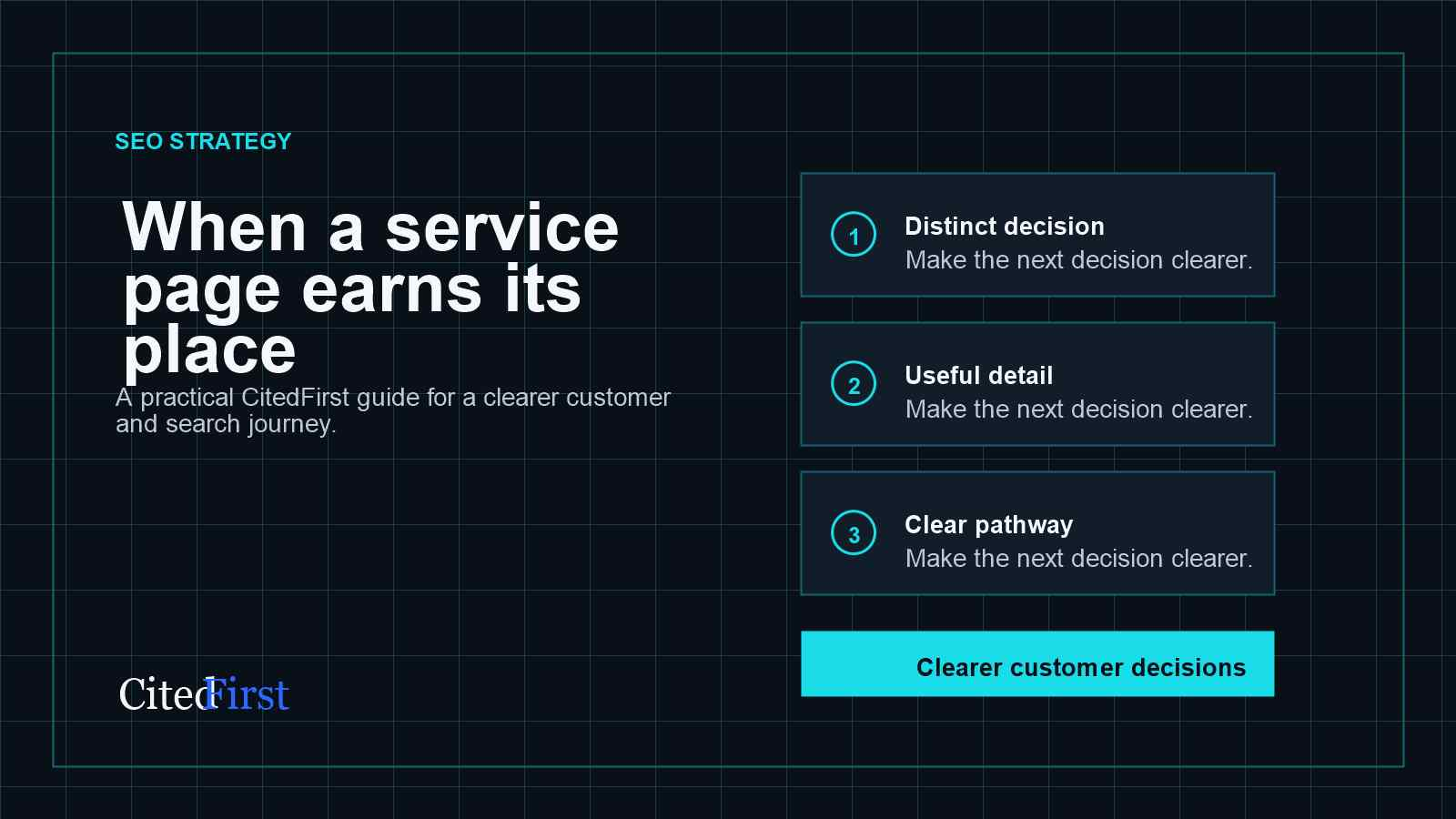
- Distinct decision: A separate page needs a customer question that another page cannot answer well. Check whether it is accurate on the page a customer is most likely to visit first.
- Useful detail: It should explain scope, fit, process and the next action for that service. Check whether it is accurate on the page a customer is most likely to visit first.
- Clear pathway: It needs links from the appropriate hub and relevant related pages. Check whether it is accurate on the page a customer is most likely to visit first.
Do not make a claim clearer by making it bigger than the truth. If the business has a boundary, a dependency, an eligibility condition or a service-area limit, explain it in straightforward language. This can reduce unsuitable enquiries while helping the right customer feel more confident about making contact.
Use the framework in a real customer journey
- Customer intent: The same buyer needs the same explanation Review people compare or request it as a distinct offer against what the customer can reasonably know and do at this point.
- Scope: It is only a minor variation of one core service Review it has its own deliverables, boundaries or process against what the customer can reasonably know and do at this point.
- Proof: The evidence and decision path are the same Review relevant evidence differs from the parent service against what the customer can reasonably know and do at this point.
- Next step: The same route works for both offers Review the enquiry requires different information against what the customer can reasonably know and do at this point.
Keep notes on what was changed, when it changed and the reason for the decision. A page may be affected by seasonality, demand, availability, advertising, technical changes or follow-up quality. A basic record prevents the business from giving credit or blame to a single edit without enough evidence.
What a useful result looks like
The immediate result should be a clearer page and a more understandable next step. Over time, the business can look for stronger query alignment, more suitable contact actions, fewer repeated pre-enquiry questions and better internal routes between related pages. These are signals to review, not promises of a fixed outcome.
Where the review identifies a wider problem, connect it to the correct owner: a service page for offer clarity, a location page for genuine coverage, a guide for an earlier-stage decision, a form route for contact friction or a technical task for access and delivery. This keeps the website coherent as it grows.
Finally, revisit the page when the service, proof, customer questions or operating details change. Maintaining a clear source is more valuable than publishing a large number of pages that become inaccurate or repetitive over time.
Turn the next decision into a clear priority
CitedFirst reviews the important pages, customer questions, visibility signals and next actions together, then identifies a practical place to begin.
Request a Free Visibility PlanA short service page action plan
- Choose one customer decision that matters commercially.
- Check the page that currently owns that decision.
- Compare visible information with what a customer still needs to know.
- Remove unsupported claims and correct inaccurate public details.
- Test the next step on desktop and mobile.
- Review relevant search and enquiry evidence before adding more pages.
A useful service page change should help a customer understand the business more easily. Record what changed and why. That makes it possible to review the effect later without assuming that one edit caused every movement in visibility or enquiries.
Use the decision consistently
These final checks keep the page focused on what a customer needs to understand, rather than adding information only to make the page look larger.
- A service page should explain the offer before asking a customer to contact the business.
- A service page should make customer fit and important boundaries easy to find.
- A service page should hold enough original information to earn its own place in the structure.
- A service page should link to related guidance only when it helps the customer continue the decision.
- A service page should not repeat a parent page with a slightly different label.
- A service page should use proof that supports the specific claim it makes.
- A service page should be reviewed when scope, process or availability changes.
- A service page should give the right customer a clear next action.
- A service page should explain the offer before asking a customer to contact the business.
- A service page should make customer fit and important boundaries easy to find.
- A service page should hold enough original information to earn its own place in the structure.
- A service page should link to related guidance only when it helps the customer continue the decision.
Use the outcome of this review to improve the relevant owner page, the supporting guidance and the next contact route together.
Keep the change proportionate. A small clarification may be enough when the service is already clear, while a larger structural problem may need a service-page review, a navigation change or a carefully planned redesign. The useful next move is the one that removes the customer’s uncertainty without creating a second page that repeats the first.
Before acting, check the information with the people responsible for the service. Confirm the scope, coverage, evidence and contact process. This prevents the page from becoming outdated or making the customer a promise that the business did not intend to make.
Frequently asked questions
Should every service have its own website page?
No. A separate page is justified when the service has a distinct customer decision, scope, proof, process or next step that a combined page cannot explain clearly.
How many service pages should a small business have?
Enough to describe the distinct offers customers genuinely need to compare. The number should follow the business model and customer questions, not a fixed SEO target.
Can similar services share one page?
Yes. Keep them together when the customer, scope, process, evidence and next action are substantially the same.
Should I create a page for every service and city combination?
Not by default. Each page needs enough unique, useful information for the customer. Repeated service-location pages can become thin and confusing.
What should a dedicated service page include?
Explain the service, customer fit, scope, process, relevant proof, boundaries and the most useful next step.
Continue with the relevant CitedFirst service
This guide explains the decision. The service page explains how CitedFirst approaches the connected commercial work and the next practical step.
Explore SEO ServicesSources and further guidance
Start with the pages and information that matter most
The Free Visibility Plan is a focused route to review the website, customer journey and public visibility information before deciding what to improve.
Request your Free Visibility Plan