
Service page writing guide
How to Write an SEO Content Brief for a Service Page
Give one real service page a clear purpose, buyer questions, verified evidence, useful links and an enquiry action before the writing begins.
Short answer
Define the page’s job before choosing words
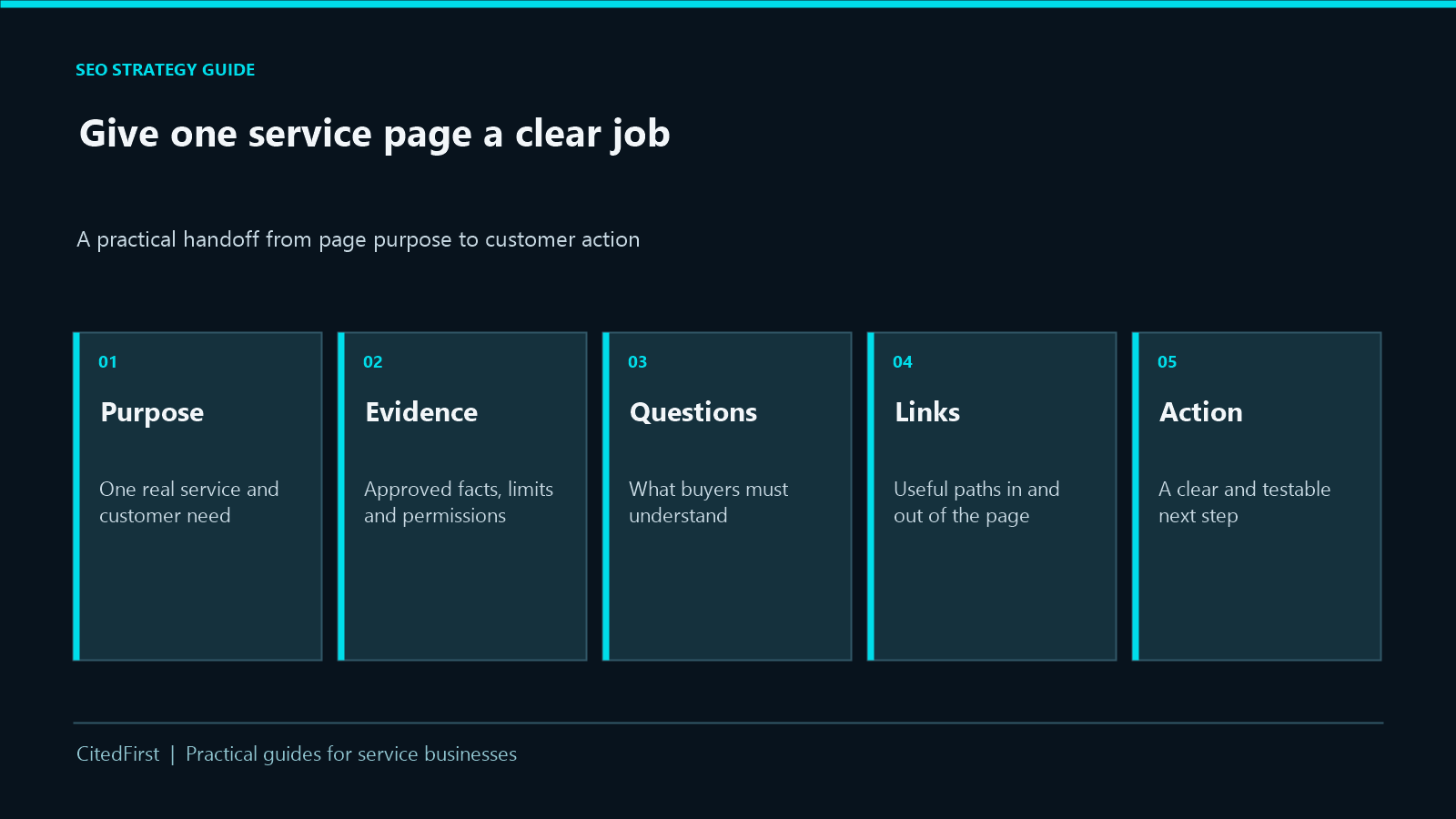
A useful SEO content brief names the service and customer, confirms the page that should own the topic, lists the questions the page must answer and identifies real evidence. It also specifies the next action and the links that help a visitor continue. It is a handoff for writing, not a worksheet for repeating a phrase.
If you are unsure whether the service needs a separate URL, use our page ownership guide first. This template begins once that decision is made.
One service
Explain the actual offer, its boundaries and who should enquire.
One page owner
Record the URL that should answer this intent so overlapping pages do not compete for the same job.
One useful route
Lead the reader from a clear answer and supporting proof to an appropriate next step.
Copyable page template
Fields for a service-page content brief
Copy this set of fields into your working document. A writer should be able to ask for a missing fact before drafting, rather than fill it with an unsupported claim.
| Field | What to supply | Owner or check |
|---|---|---|
| Service and page role | Actual service name, customer problem and whether this is a new page or an improvement to an existing URL. | Business owner confirms the offer; SEO lead checks overlap. |
| Audience and intent | Who is choosing, what they need to compare and how close they are to an enquiry. | Sales or service team supplies real questions. |
| Scope and exclusions | What is included, what requires assessment and what is not provided. | Delivery team approves every claim. |
| Genuine area | Actual operating or delivery area where location affects suitability. | Business owner checks coverage. |
| Evidence | Approved project examples, process detail, images, qualifications or policy links where relevant. | Identify source, permission and reviewer. |
| Questions and headings | Buyer questions, a proposed H1 and the sections needed to answer them. | Writer checks usefulness and hierarchy. |
| Metadata and links | Descriptive title/description; relevant inbound guides and outgoing service, sector or proof pages. | SEO lead checks purpose and working URLs. |
| Next action | Call, quote, visit, booking or discussion; what the buyer should provide. | Sales team checks the response process. |
Do not use a keyword-density quota as a substitute for a truthful, complete answer. Google advises writing helpful content for people and says it has no preferred word count.
Illustrative example
How a brief might look for an office fit-out page
This is a hypothetical production example, not a CitedFirst client or a claim about any actual company. Every business fact would need approval before a public service page used it.
Page purpose and audience
Proposed topic: office fit-out services. Audience: a facilities or operations buyer comparing providers for a workspace change. Owner URL: choose the existing relevant page if one already covers the offer; otherwise propose one new service URL.
Primary question: can this provider handle the required scope and constraints? That question is more useful than “How many times can we repeat office fit-out?”
Facts to obtain before writing
- Which survey, design, build or coordination tasks are genuinely offered?
- Who is responsible for third-party trades and approvals?
- Which sites or areas can the team actually serve?
- What proof may be published with client permission?
- What is the first assessment or enquiry step?
Proposed page flow
State the offer and suitability; clarify included work and boundaries; describe the assessment and delivery process using approved facts; answer programme, occupation, access and stakeholder questions where relevant; show permission-cleared evidence; end with the right contact route. The writer should mark unknown facts for the business to resolve, not turn these prompts into promises.
Research and evidence
Use customer questions to shape the brief
Start with questions the sales and delivery teams actually hear. Search data may reveal wording and missing topics, but it cannot decide the service scope. Group closely related questions under the appropriate page instead of creating a URL for every variation. Our guide to useful customer questions shows how to choose answers that help a buyer.
For each substantial claim, write down the source. A process claim may need a delivery owner; a project outcome needs dated evidence and permission; an accreditation needs a current document. Where proof is unavailable, use accurate process detail and plain boundaries.
Write a descriptive proposed H1 and title. The main phrase can appear naturally where it makes the page clear. The description should reflect what a visitor will actually find, not promise a result the page cannot support.
Link map
Connect the page to the right supporting pages
Links into this page
Identify the service overview, relevant sector page and one or two guidance articles that can introduce this specific service. Give each link a reason and a useful label. Do not insert it on every page merely to raise a count.
Links out of this page
Send visitors to a relevant approved project, a genuinely distinct related service or a detailed guide when that helps them choose. The quote or contact route remains obvious on the service page itself.
Our internal linking guide explains the broader structure. A high-value service page guide covers the visitor-facing page anatomy; this brief turns those decisions into instructions a writer can use.
Approval
Check the finished page against the brief
- Does the page describe a real service for a clear audience and situation?
- Is the scope accurate, including any necessary limitations?
- Can the business verify every project, image and result claim?
- Does one H1 introduce a coherent sequence of headings and answers?
- Do the title and description accurately match the page?
- Do the links have a useful destination and the enquiry route work on a phone?
- If an old URL changed, has its destination been checked?
Ask the business owner to approve service truth and the page’s next step. An SEO score can flag omissions, but it cannot verify that the service is genuine or that the page resolves the buyer’s question.
If you want help reviewing and improving a live service page against this brief, our SEO services cover page structure, content priorities, internal links and measurement.
SEO content brief FAQs
Is a content brief the same as finished page copy?
No. The brief records the page’s purpose, required facts, questions, evidence, structure, links and approval owners. The writer then turns approved inputs into visitor-facing copy.
How many keywords should the brief contain?
Enough language to describe the core intent and closely related questions. A long phrase list or density target cannot replace a clear service description and buyer answer.
Does every service variation need a page?
No. Give a distinct page only to a genuinely distinct offer or customer decision that can be supported with useful content. Otherwise improve the existing owner.
What if project evidence is unavailable?
Record the gap. Use approved process and scope information, then plan to add suitable evidence when available. Do not manufacture results or imply permission.
Source and further reading
Google’s people-first content guidance describes original usefulness, accurate claims and a satisfying reader experience. Use it to assess whether the finished page helps a person make a decision.
Take the next step
Give an important service page a clear job
CitedFirst can review page ownership, customer questions, evidence and internal links before a new page is written or an existing one is improved.