
Website Visibility & Conversion
What Should a High-Value Service Page Include?
A high-value service page should help a serious buyer understand suitability, scope, risk, evidence and the next step before committing time to an enquiry.
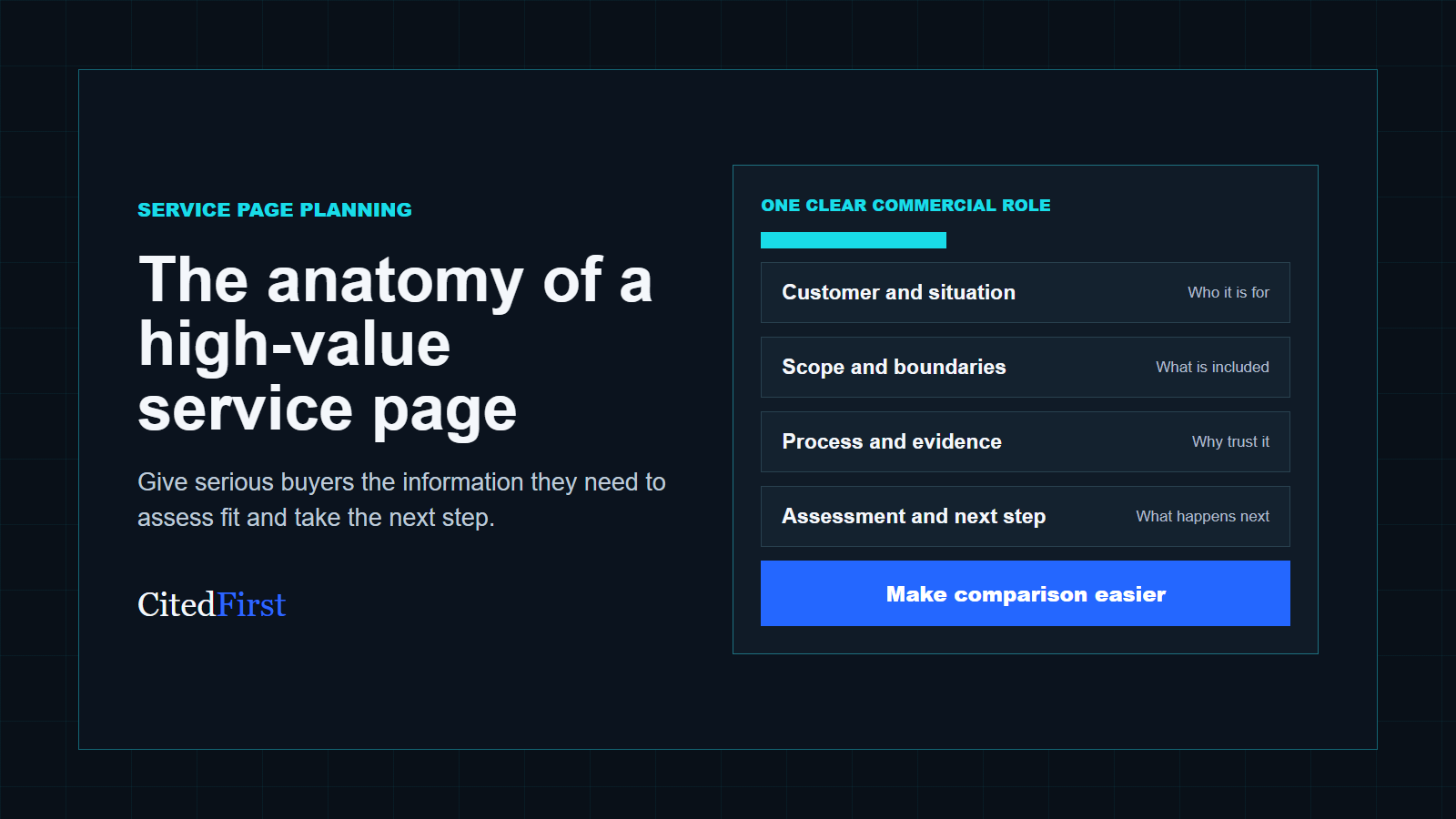
A high-value service page should explain who the service is for, the problem or project it addresses, what is included, how the work is assessed, which evidence supports the offer and what happens after contact. Its job is not to publish every technical detail. Its job is to reduce the uncertainty that prevents a suitable customer from starting a serious conversation.
A high-value service page supports a bigger decision
Customers evaluate a high-value service differently from a low-risk purchase. They may need to involve colleagues, compare approaches, confirm technical suitability, understand dependencies or justify the decision internally. A short page with a broad promise and a contact button does not support that process.
The value is not defined only by price. The work may affect business continuity, property, safety, reputation, customer experience or a wider project. Even when pricing cannot be published, the page can explain how the business assesses fit and what information shapes a proposal.
A useful high-value service page therefore acts as a decision document. It helps the buyer recognise the right service, understand the available route and prepare a better enquiry. It also gives search engines and AI-assisted systems a clearer description of the service without relying on a list of keywords.
Start with the service, customer and situation
The opening should identify the service in direct language and show who it is designed to help. A generic headline such as “solutions that transform your business” forces the customer to decode the offer. A descriptive heading gives the page a stable subject and makes the intended journey easier to understand.
Use the supporting paragraph to add the customer type, project context or problem. For example, a commercial installer may distinguish planned refurbishment from emergency repair. A consultant may separate a strategic review from ongoing implementation. A construction supplier may serve principal contractors differently from individual property owners.
The high-value service page should also state important exclusions early enough to prevent confusion. Clear boundaries do not weaken the offer. They demonstrate that the business understands where it can provide value and where another route may be more appropriate.
| Page element | Buyer question | What useful content provides |
|---|---|---|
| Opening | Is this the right service for my situation? | Service, audience, context and main outcome. |
| Scope | What can the business actually handle? | Included work, options, responsibilities and boundaries. |
| Assessment | How will you understand my need? | Required information, review steps and dependencies. |
| Process | What happens after I make contact? | Accurate stages from enquiry to recommendation or quotation. |
| Evidence | Why should I trust this offer? | Relevant projects, qualifications, methodology or verified reviews. |
| Next step | What should I do now? | A clear action and explanation of what follows. |
Explain scope without publishing a vague feature list
A list of activities can help scanning, but a high-value service page needs to connect those activities to the customer’s decision. Group related work into understandable stages or options. Explain why an assessment may be needed and what can change the recommended route.
Distinguish what the business provides from what the customer, another supplier or a project partner must provide. This is especially useful where planning permission, access, surveys, technical information, existing systems or third-party approvals affect delivery. It prevents the page from implying that one provider controls every part of the outcome.
Where several versions of the service exist, compare them in customer language. Explain which situation each option suits, what the key difference is and when a combined approach may be sensible. Do not invent fixed packages merely to make the high-value service page look tidy.
Answer the questions that delay serious enquiries
Sales conversations often reveal the information the page is missing. Review emails, call notes and form submissions for recurring questions. Customers may ask about minimum project scope, coverage, lead times, compatibility, evidence, access, responsibilities, reporting or support after delivery.
Not every answer belongs in a frequently asked questions section. Important decision information should appear in the main narrative where it supports the relevant claim. Use FAQs for residual questions that remain useful after the core explanation.
A high-value service page should not disclose confidential methods, customer information or technical details that require assessment. It should explain enough of the approach to show that the business has a coherent process and knows which information matters.
Give the high-value service page a clear commercial role
CitedFirst helps service businesses assign one customer decision to each important page, strengthen its supporting information and connect it with useful internal links.
Explore CitedFirst SEO ServicesShow how the initial assessment works
A high-value enquiry often begins with incomplete information. Explain what the business needs to understand before recommending work. This may include the customer’s objective, current situation, project location, constraints, stakeholders, timing and available evidence.
Describe the initial review accurately. It may be a telephone conversation, site visit, document review, discovery session or visibility assessment. Avoid calling it an audit if the business does not perform a complete audit. Avoid promising a quotation before the necessary information can reasonably be reviewed.
The assessment section can also help a customer prepare. A simple list of useful documents, measurements, URLs, photographs or project details can make the first contact more productive. This improves the value of the enquiry for both sides.
Describe the process at the right level
Customers want to know that the work has a structure, but they rarely need an internal operating manual. Present the stages that change the customer’s experience: initial review, scope confirmation, recommendation, delivery, checking and follow-up.
At each stage, explain the output or decision. The first call may determine whether a site visit is necessary. A review may produce priorities rather than a complete specification. A proposal may depend on access or information supplied by the customer. This level of clarity helps a high-value service page feel credible.
Only publish timelines when the business can support them and the context is clear. If timing varies, explain what affects it rather than creating a universal promise. The same principle applies to costs, availability, warranties and results.
Use evidence that matches the service claim
Proof should reduce the specific risk attached to the decision. A completed project can demonstrate relevant scope. A verified qualification can support technical competence. A clear methodology can show how recommendations are formed. A genuine review can support the customer experience described on the page.
Do not rely on a long strip of logos without explaining their relevance. Do not imply membership, accreditation or partnership unless it is current and verifiable. Do not turn an unrelated project into evidence for a different service.
When public case studies are not yet available, the high-value service page can still explain the evidence a customer should expect during the enquiry. This may include project examples shared with permission, documentation, references, process information or a review of the customer’s requirements.
Connect the page to projects, sectors and locations carefully
A service page owns the service decision. Project pages support it with evidence. Sector pages explain how customer needs differ by industry. Location pages explain genuine operating context. These page types should support one another instead of repeating the same sales copy.
Link to the most relevant evidence and context from the high-value service page. A project should link back to the service it demonstrates. A sector page should link to the applicable services. A location page should not claim a local office or delivery capability that does not exist.
The guide to service pages versus location pages explains these ownership boundaries. The internal linking guide for multi-service businesses shows how to connect the layers without creating a wall of unrelated links.
Build a useful enquiry route for a complex service
The primary CTA should match the decision stage. “Buy now” will not fit a service that requires assessment. “Contact us” may be too vague. A clearer route might invite the customer to request a project review, send requirements, discuss suitability or arrange an initial consultation.
Explain what happens after the action and which information helps. Use a form that captures enough context without demanding details the customer cannot reasonably provide. Offer an alternative contact method where it is genuinely monitored.
A high-value service page may benefit from a CTA near the opening, after the scope or process section, and at the end. Keep the action consistent. Repeatedly changing from quotation to booking to audit can make the next step feel uncertain.
Support different people involved in the decision
A higher-value purchase may involve the person experiencing the problem, a technical reviewer, a budget holder and a final decision-maker. The page should remain readable for all of them. Begin with the commercial situation, then provide deeper scope, evidence and process detail.
Use clear headings, tables and concise lists to make information easy to locate. Explain unfamiliar terms on first use. Provide downloadable documents only when they contain genuine, maintained information and remain accessible.
Do not hide essential information in an image. Search engines, assistive technology and customers on small screens need meaningful text. A diagram can support the high-value service page, but the surrounding copy should explain its message.
Make the page useful for search and AI-assisted discovery
Search systems need a crawlable page with a clear subject, useful text, descriptive internal links and structured data that matches what a visitor can see. Google’s people-first content guidance recommends original, complete and useful material rather than pages created mainly to attract search visits.
Answer the main question near the beginning, then support it with context and evidence. Use the terminology customers use alongside accurate service language. Avoid repeating one phrase mechanically. A high-value service page can rank for many related searches when its purpose is clear.
There is no special schema that makes a page eligible for AI recommendations. Use appropriate Service or WebPage structured data on a commercial service page where the visible content supports it. Keep factual claims consistent across the website, public profiles and third-party sources.
High-value service page review
- State the service, customer and situation in the opening.
- Explain included work, options, responsibilities and boundaries.
- Identify the questions a buyer must answer before proceeding.
- Describe the initial assessment and the next delivery stages.
- Connect each important claim with relevant, verified proof.
- Link to useful projects, sectors or locations without duplicating them.
- Test the complete enquiry route on mobile and desktop.
Ready to commission or rewrite the page? Turn these decisions into an SEO content brief for a service page, with a clear audience, scope, evidence and useful internal links.
A high-value service page should make comparison easier
The strongest page is not necessarily the longest. It is the page that helps a suitable buyer understand the service and compare it responsibly. Add detail when it answers a real question, reduces risk or clarifies the next step. Remove detail that exists only to make the page look comprehensive.
Review the page after real conversations. If customers misunderstand scope, add clarity. If unsuitable leads repeatedly request work outside the offer, strengthen boundaries. If suitable buyers need the same evidence before proceeding, bring that evidence closer to the claim.
This creates a useful feedback loop: the high-value service page prepares better enquiries, and those enquiries reveal what the page should explain next.
Frequently asked questions about high-value service pages
How long should a high-value service page be?
Use enough content to explain suitability, scope, process, evidence and the next step. Complex services may need a detailed page, but there is no useful target that applies to every business. Clarity and decision value matter more than padding.
Should a high-value service page show prices?
Show prices or starting points only when they are accurate and useful. If pricing depends on scope, explain what affects the proposal and what information is required. Do not create a misleading package simply to display a number.
Does every service need a separate page?
No. A separate page is useful when the service has a distinct customer need, scope, process, evidence or search intent. Closely related options may be clearer on one strong page.
What proof should appear on the page?
Use proof that supports the specific claim: relevant projects, verified qualifications, genuine reviews, documented methodology or approved outcomes. Avoid unrelated logos or unsupported statements.
Should the page include a long contact form?
Ask only for information needed to assess the enquiry. A complex service may require more context, but every field should have a purpose and the form must remain usable on mobile.
Sources and further guidance
Give every important service a clearer job
CitedFirst connects service-page content, website structure, internal links and search intent around the decisions customers actually need to make.
Explore SEO Services