
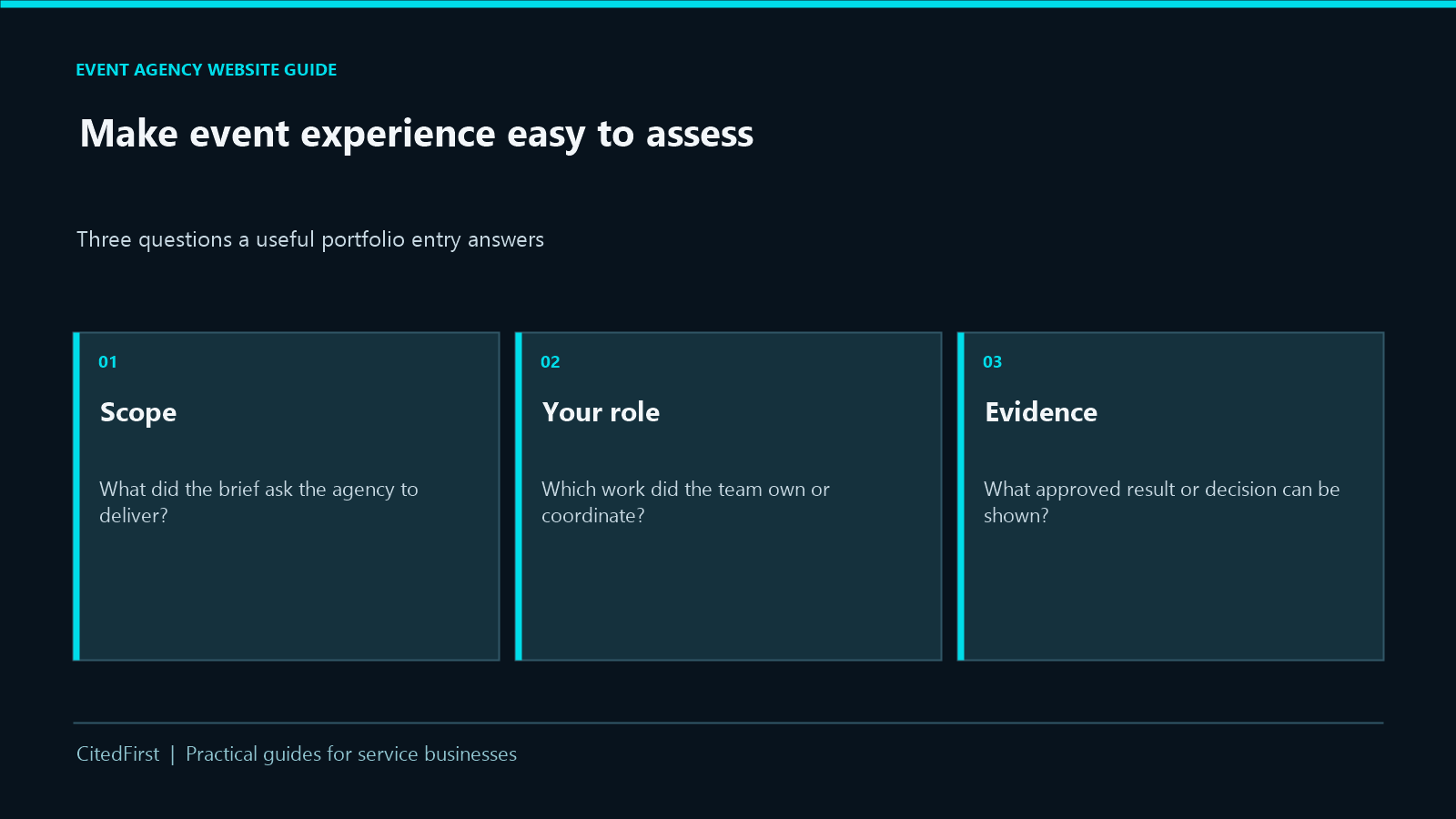
Event agency website guide
What Should an Event Management Company Show on Its Website?
Help a buyer understand the events you take on, the work your team owns and the evidence behind your experience before they send a brief.
Short answer
Make an agency easy to assess
An event management website should show the formats it handles, what the agency actually delivers, examples with a clear role and a sensible way to start a project conversation. A gallery alone rarely tells a buyer whether your team organised the event, supplied one element or worked alongside other partners. The event agency website checklist below turns those questions into a practical review.
What do you do?
Name the event formats and services the team can actually deliver. Explain where strategy, creative, production and logistics start or end.
What have you done?
Use approved project evidence that identifies your role, the brief and the decisions you made, rather than unexplained photographs.
How do we begin?
Invite a useful first brief with objective, audience, date window, location status and likely scale. Let buyers say what is still unknown.
Services and responsibility
Describe the work your team owns
Buyers may compare an agency with a venue, production supplier, catering team or temporary-structure provider. A helpful website distinguishes those roles without overstating its own remit.
Map the actual scope
- Event strategy and concept, where provided.
- Creative design and attendee experience.
- Production, technical and on-site management.
- Venue or supplier selection and coordination.
- Delegate, guest and stakeholder communications.
Only list items your business offers. When a partner leads an element, say so in project examples.
Show the boundaries
A project description can say who acted as organiser, who controlled the venue and which specialist contractors delivered their own work. These distinctions help a buyer ask the right questions and avoid attributing every outcome to one firm.
For event health and safety, the HSE describes different organiser, contractor and venue responsibilities. That guidance is a reason to write accurately, not a substitute for a project-specific safety plan.
Copyable project card
What a useful event portfolio entry contains
Use this structure for a real project only when the client has approved the facts and media you share. Leave out private details rather than filling gaps with guesses.
| Field | Question to answer | Evidence to prepare |
|---|---|---|
| Objective | What was the event meant to achieve? | Approved brief summary or public programme. |
| Format and audience | Was it a launch, conference, activation, celebration or another format? Who attended? | Approved category and audience description; scale only if verified. |
| Your role | Which elements did your team lead, coordinate or supply? | Scope statement distinguishing partners and venue. |
| Constraints | Which date, location, accessibility, technical or operational needs shaped the work? | Facts cleared for public use. |
| Decisions | How did the team respond to those constraints? | Process notes, plans and approved photographs. |
| Outcome | What can be documented without exaggeration? | Approved observations or numbers with source and period. |
Illustrative layout, not a client example: “Objective: [approved goal]. Our role: [specific deliverables]. Constraints: [approved facts]. Evidence: [permission-cleared images or documented outcome].” The brackets are fields to complete from a real project before publication.
Confidential work
When the full project cannot be shown
Ask what the client permits: an anonymised sector, event format, scope of work or process description may be possible even when names and photographs are not. State your own contribution precisely. Do not imply approval through a logo or stock image.
Proof belongs beside the claim it supports. Our guide to trust signals before an enquiry explains why a visitor needs context, not a decorative list of badges.
Page structure
Help buyers navigate the range
Use a clear overview of event formats and capabilities, then link to the examples most relevant to each buyer. A separate page for every near-identical format is rarely useful. Create one only when the audience, service scope and evidence are meaningfully distinct.
Keep the mobile portfolio readable. Give images useful captions, concise alt text and predictable controls. A buyer should not have to scroll through a long gallery to find the team’s role.
Enquiry journey
Ask for a useful first event brief
A good enquiry form invites enough context for a useful response without demanding a completed specification. These fields can be prompts in a form or a short briefing email.
Core inputs
- Event objective and desired audience experience.
- Format under consideration, if known.
- Date or date window; location and venue status.
- Indicative audience size and any access requirements.
Commercial and decision context
- Strategy, creative, production or logistical support needed.
- Budget stage or range, if it can be shared.
- Decision process and the next useful meeting.
- Anything still undecided.
Do not treat “unknown” as a failed brief. An early conversation may help define the right format. The website can explain how that conversation works and what happens after submission.
For support making event services easier to find and compare online, see CitedFirst’s event management sector service.
Questions event agencies ask
What if a client will not approve a named case study?
Ask whether an anonymised account of the scope and your role is permitted. If not, use a clear process explanation and show only evidence you have rights to share.
Should every event format have its own page?
Only when the format serves a distinct buyer need and the page can explain a real offer with useful evidence. Avoid near-identical pages that change only a format label.
What if we have no publishable outcome numbers?
Show what can be verified: the challenge, scope, responsibilities, approved project materials and decisions. Do not invent a return or attendee metric to fill the gap.
How detailed should the first enquiry be?
Request enough context to identify fit and the next conversation. Let buyers provide approximate dates, scale and budget stage where exact decisions are still being made.
Sources and further reading
Take the next step
Make event capability easier to find and trust
CitedFirst helps event businesses present their services, project evidence and enquiry routes clearly in search and on the website.