
Website Visibility & Conversion
How Can a Business Get Better-Qualified Website Enquiries?
Better-qualified website enquiries come from clearer positioning, useful service boundaries, relevant proof and a contact route that asks for the information needed to assess fit.
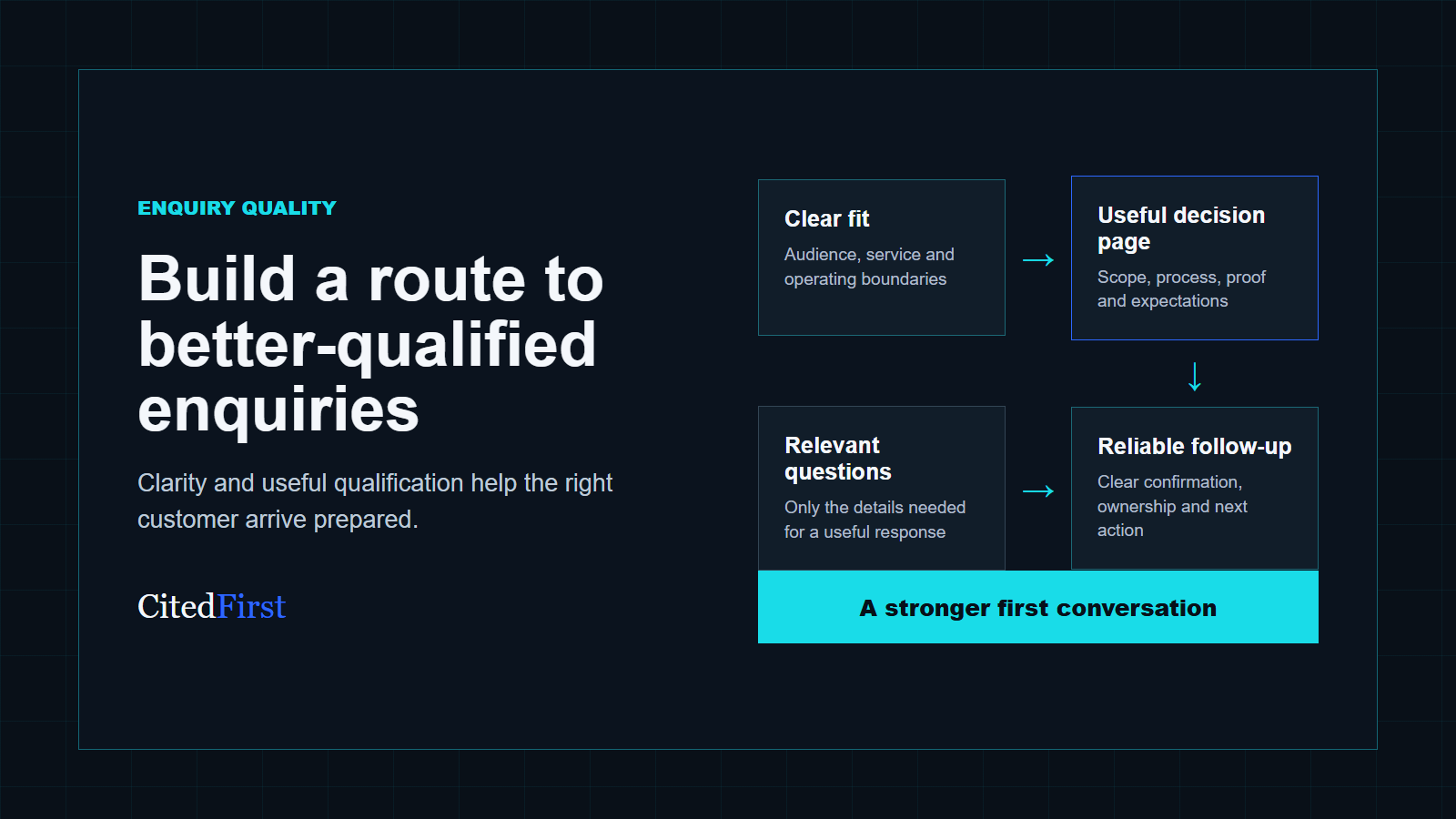
To generate better-qualified website enquiries, make it easy for suitable customers to recognise themselves and easy for unsuitable customers to recognise the boundary. Explain who the service is for, what is included, where it is available, what evidence supports it and which details are needed for a useful first response.
Define what qualified website enquiries mean for the business
“More leads” is not a precise target. A qualified enquiry should match the service the business wants to provide, the type of customer it can help, the genuine operating area and enough practical conditions to justify a conversation. The definition will differ between businesses.
A builder may need project type, location and likely timing. A commercial supplier may need volume, specification and delivery requirements. A consultant may need the business model, current challenge and decision stage. Qualified website enquiries are easier to improve when the business records these characteristics consistently.
Start by reviewing recent contacts. Mark which became useful conversations, which were unsuitable and why. Common reasons may include wrong service, wrong geography, unrealistic timing, missing authority, insufficient scope, incompatible budget or a request for free technical work. These patterns show what the website should clarify.
| Qualification area | What the page should clarify | Useful enquiry information |
|---|---|---|
| Service fit | The work provided and important exclusions | Service or project type |
| Customer fit | The organisations, properties or situations served | Business or customer context |
| Location fit | Genuine operating area and delivery model | Project or service location |
| Scope fit | Minimum, typical or specialist requirements where real | Scale, quantity or main constraint |
| Timing fit | How availability and planning are assessed | Desired start or decision date |
| Decision fit | The next review, quotation or consultation stage | What the customer needs to decide |
Use the opening to qualify, not merely attract
The opening headline and supporting paragraph should state the real offer. Broad promises may increase curiosity but reduce qualified website enquiries because visitors cannot tell whether the business fits their need. Use concrete service language, the intended customer and the main situation or outcome.
If the offer is commercial only, say so. If the service requires an existing system, planned project, minimum order or site access, explain that at the appropriate point. If the business serves customers nationally online but provides on-site work only in selected areas, separate those delivery models clearly.
Qualification should remain respectful. The page should help customers self-select, not make them prove their worth. Avoid language that sounds dismissive or places every risk on the customer. Explain boundaries in the context of providing the right service and response.
Create a separate page when the buying decision is different
Sending every visitor to one general services page makes qualification difficult. A dedicated page is useful when a service has a different problem, audience, scope, process, evidence or next step. It gives qualified website enquiries a relevant destination and gives unsuitable visitors more accurate information.
Closely related services do not always need separate pages. If the customer considers them together and the explanation would be largely identical, one well-organised page may be stronger. The page structure should follow meaningful decisions rather than a list of keyword variations.
The existing guide to service pages versus location pages explains how service and geographic intent should be separated. The goal is one useful owner for each important decision, supported by contextual internal links.
Build qualified website enquiries around the right pages
The Free Visibility Plan identifies where page roles, customer questions, proof and enquiry routes are unclear, then sets out practical priorities.
Request a Free Visibility PlanExplain scope before the customer reaches the form
A contact form should collect information, not carry the entire qualification job. Customers need enough page content to decide whether completing it is worthwhile. Explain the service components, relevant options, operating context and boundaries in readable sections.
Use examples to clarify situations, but do not invent client stories. A page can describe typical decision scenarios without claiming that a named project occurred. For complex work, explain what can be confirmed only after a review, site visit, document check or discovery conversation.
Qualified website enquiries improve when the page answers the concerns that usually cause an unsuitable request. If customers assume a supply-only company also installs, clarify responsibility. If a service supports planned work rather than emergencies, separate those routes. If prices depend on scope, explain the inputs instead of hiding the issue.
Use relevant proof to support customer confidence
A suitable customer may still hesitate if the page provides no reason to believe the offer. Connect claims with verified evidence. Relevant proof can include an approved project, genuine review, current qualification, named methodology, process detail, team responsibility or a source that explains an external requirement.
Proof should help the customer evaluate the same service shown on the page. A general review about friendly communication does not prove specialist capability. An unrelated case study may create more uncertainty. Place the strongest relevant evidence near the claim it supports.
Where proof is still being developed, qualified website enquiries can be supported by transparent process and boundaries. Explain what the business will review, what the customer receives and what cannot be confirmed before assessment. Do not fill the gap with invented statistics or guarantees.
Write calls to action that set an expectation
“Get in touch” is flexible but gives little information. A more specific CTA can describe the next step: request a visibility plan, discuss project suitability, send service requirements or ask for an initial review. The right wording depends on what the business can reliably provide.
Add a short explanation beside the action. Tell the customer what information helps, whether the response will be by email or telephone and whether the next stage is a review, booking or quotation. Do not promise response times unless they are confirmed operationally.
Keep one primary action across the page. Secondary telephone or email options may remain available, but several competing offers can weaken qualified website enquiries by making the path feel uncertain.
Ask only for information that improves the response
Form fields should be connected to a real decision. Name and contact details identify the person. Service type routes the message. Location checks genuine coverage. A short project description provides context. Timing can help assess planning. Remove fields that are collected out of habit and never used.
Do not ask a customer to provide information they are unlikely to know. Use plain labels, examples and optional fields where appropriate. If the project requires a later technical assessment, make that clear rather than turning the first form into a specification.
Before changing fields, decide whether the customer is asking for a conversation, a scoped quote or a defined booking. The quote form vs contact form vs booking guide helps match the route to what the customer can reasonably know at this stage.
For qualified website enquiries, a well-designed dropdown can be useful when the options are complete and understandable. Free-text remains important for unusual context. Avoid a choice called “Other” as the only route for several important services that should have their own pages. The form should help organise qualified website enquiries without forcing every customer into an inaccurate category.
Keep the contact experience accessible and reliable
Visible labels, meaningful error messages, keyboard access, logical focus and suitable input types make the form usable for more people. Touch targets should be comfortable on mobile. Validation should explain how to correct the field without deleting information already entered.
Test the form on the public site at desktop, tablet and mobile widths. Submit a real test and confirm that the on-screen success state, stored entry and email notification agree. A message that says “sent” is not proof that the receiving inbox got it.
Protect the form from spam with proportionate controls that do not create unnecessary friction. Keep consent and privacy language clear. Qualified website enquiries depend on trust during the final step as much as they depend on the content above it.
Connect informational content to the correct service
A customer may begin with a question rather than a service name. Articles can help them understand the problem, compare approaches and identify the correct commercial page. Each article should have one main destination that matches the decision it supports.
Use natural anchor text that explains the destination. Link from a guide about website structure to the relevant SEO or website service. Link from a sector guide to the sector owner and supporting services. Link from the service page back to useful guidance where the customer may need more explanation.
The CitedFirst guide to internal links for multi-service business websites provides a practical model. Relevant pathways can support qualified website enquiries because customers can move sideways to the detail they need without returning to a crowded menu.
Use search language without attracting the wrong intent
A page should use the terms customers understand, but visibility for a broad phrase is not always valuable. Review the questions and modifiers attached to the service: commercial or domestic, planned or emergency, supply or installation, local or national, strategic or implementation.
Include the relevant distinctions in headings and body copy where they help. Do not create a page for every variation. Search engines can understand related language, and Google’s SEO Starter Guide recommends writing with readers and their different search terms in mind.
Qualified website enquiries are more likely when the page’s search promise matches its visible content. The title, description, H1 and opening should lead to the same service and customer decision.
Review enquiry outcomes as content evidence
Create a small, consistent classification for new contacts: suitable, potentially suitable, unsuitable, spam or unclear. Record the source page and the main reason for the classification. Keep personal data handling appropriate and avoid collecting more than the business needs.
Review patterns monthly or after a meaningful number of enquiries. If many suitable customers ask the same question, add the answer to the owner page. If a page attracts recurring poor-fit requests, strengthen its boundaries. If visitors abandon a particular step, test its language and usability.
Do not judge qualified website enquiries from one week or one ranking observation. Seasonality, capacity, paid campaigns, referral activity and market changes can affect the result. Record substantial website changes so later comparisons have context.
Qualified enquiry improvement plan
- Define the services, customers, areas and scope that represent a suitable enquiry.
- Assign each important service decision to one owner page.
- Place suitability, scope and boundaries before the enquiry form.
- Connect important claims with relevant, verified proof.
- Use one primary CTA that explains the next step.
- Collect only the details needed for a useful response.
- Classify enquiry outcomes and improve pages from recurring patterns.
Qualified website enquiries come from a connected journey
No single headline, schema type or form field can qualify every customer. The outcome depends on the relationship between discovery, page purpose, service detail, proof, operating context, user experience and follow-up.
Start with the owner page for the service that matters most. Improve its opening, scope, proof and next step. Connect it to the homepage, relevant projects, sectors, locations and guidance. Then test the form and review the enquiries it produces.
This focused approach is easier to measure than changing the whole website at once. It also creates a reusable standard for other services once the business can see which information genuinely improves qualified website enquiries. Over time, the strongest pages reveal which questions repeatedly lead to qualified website enquiries and which questions need clearer answers.
Frequently asked questions about qualified website enquiries
What makes a website enquiry qualified?
A qualified enquiry matches the intended service, customer, genuine operating area and enough practical conditions to justify a conversation. The exact definition should reflect how the business actually works.
Will a longer form produce better-qualified enquiries?
Not automatically. Ask for information that improves assessment and remove fields that are not used. Qualification should begin in the page content rather than relying entirely on the form.
Should we publish prices to filter leads?
Publish prices or starting points only when they are accurate and helpful. Where scope changes the price materially, explain the factors and required assessment instead of presenting a misleading figure.
How can SEO improve lead quality?
Clear page ownership, titles, descriptions and content can align the page with a more suitable search intent. SEO cannot guarantee lead quality, but it can reduce mismatches between the search promise and the actual offer.
How often should we review enquiry quality?
Use a consistent monthly or volume-based review that fits the business. Consider seasonality and other marketing activity, and record significant website changes before comparing periods.
Sources and further guidance
See which part of the enquiry journey needs attention
The Free Visibility Plan reviews page roles, service clarity, search intent and contact routes, then identifies the priorities most likely to improve the customer journey.
Request your Free Visibility Plan